
Written by: JJ Tan, Founder, Jelly
Key Takeaways
- Recipe management software training works best when each role has clear competency standards that define tasks and evidence of ability.
- Four role groups carry different requirements: line cooks and floor staff, kitchen managers and chefs, QA and compliance officers, and administrators and IT leads.
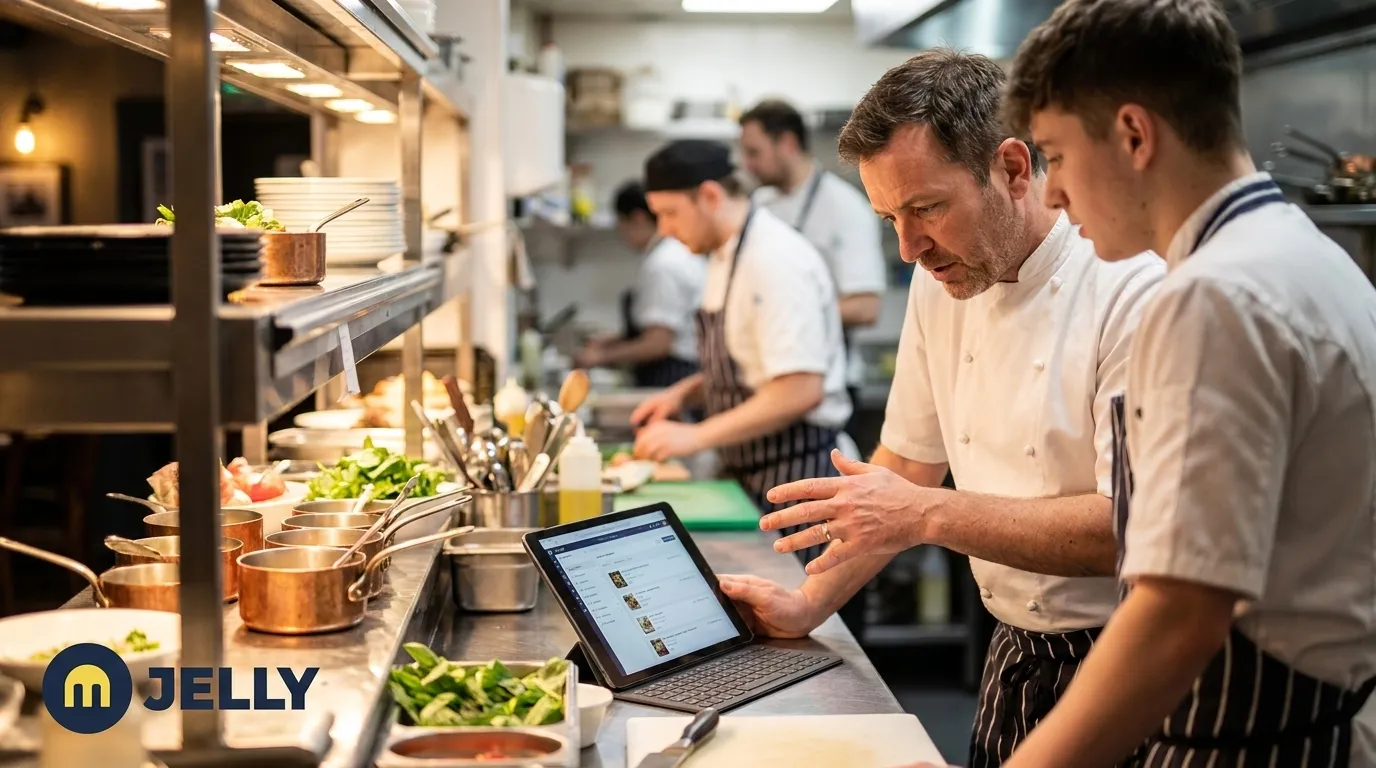
- Training must run on the devices used at the pass, with mobile-first delivery essential in UK hospitality because of high turnover and limited computer access.
- Competency must be shown through practical sign-off in live service, with records capturing named, dated completion, version control, knowledge-check results and refresher history for HACCP audits.
- Jelly reduces training effort through automated invoice scanning, live dish costing and Price Alert notifications that handle complex work in the background.
See Jelly In Action For Your Team
Scope For UK Restaurant, Pub And Hotel Kitchens
This guide focuses on UK restaurant, pub and boutique hotel operators, rather than food manufacturers. Most search results and AI Overviews mix these groups together. Manufacturing concerns such as PLCs, batch controllers and lot-level genealogy traceability do not apply to a 40-cover pub kitchen. The compliance spine that matters here is clear for a UK hospitality operator: the 14 regulated allergens, Natasha's Law and PPDS labelling, HACCP documentation, and the Food Standards Agency's training evidence requirements.
The assumed reader has already chosen their software and is two to six weeks from go-live. They need a plan they can hand to a head chef and a general manager on Monday morning. The evaluation lens throughout stays simple and practical. Each requirement answers two questions: what must this person be able to do, and how do we know they can?
Plan Your Rollout With A Jelly Specialist
What Training Do Line Cooks And Floor Staff Need On Recipe Management Software?
Line cooks and floor staff must be able to perform the following tasks on the platform:
- Locate an approved recipe on the device used at the pass, such as a tablet or touch-screen
- Scale portions correctly for the cover count or order
- Read allergen alerts attached to a dish or ingredient
- Flag discrepancies between the recipe and what is available in the kitchen
- Use the device during live service without supervision
Competency sign-off statement: A line cook is competent when they can independently locate, scale and execute an approved recipe and identify allergen alerts without supervision.
This group has the highest turnover, which means training must be repeatable and quick to deliver. UK hospitality typically runs at 30–40% annual turnover, and over 70% of the restaurant workforce has no regular computer access at work. Because staff cannot step away to a desktop, training has to happen on the actual device used during service. Mobile-first delivery is therefore the only realistic channel for this group.
While line cooks and floor staff focus on executing recipes in service, kitchen managers and chefs carry responsibility for costing and margins behind those dishes. Their training builds on the same platform but shifts to financial control and menu performance.
What Training Do Kitchen Managers And Chefs Need On Recipe Management Software?
Kitchen managers and chefs must be able to perform the following tasks:
- Enter ingredient prices from scanned invoices
- Handle unit conversions and yields without manual calculation
- Calculate food-cost percentage for a dish
- Build and cost new dishes within the platform
- Review live GP margins across the menu
- Act on Price Alert notifications when supplier prices shift
Competency sign-off statement: A kitchen manager is competent when they can cost a new dish from scanned invoice data, explain its GP margin, and adjust or re-price it in response to a supplier price change.
Costing and margin competence sits as a training requirement rather than a software feature. A chef must understand what drives a GP change and how to respond. The ability to read a live GP figure only becomes useful when they can explain the movement and take action. For a deeper treatment of recipe costing methodology, see Best Recipe Costing Software for UK Restaurant Chefs. For recipe governance and version control, see Recipe Version Control Software for Kitchens.
QA and compliance officers extend this work into allergens, HACCP and audit evidence, using the same data to satisfy legal and inspection standards.
What Training Do QA And Compliance Officers Need On Recipe Management Software?
QA and compliance officers must be able to perform the following tasks:
- Name and identify all 14 regulated allergens
- Explain how allergen data flows through recipes and sub-recipes in the platform
- Apply Natasha's Law and PPDS labelling requirements to relevant menu items
- Produce HACCP documentation from platform data
- Map training records and digital logs to audit evidence requirements
UK compliance spine: UK food law requires food businesses to declare 14 regulated allergens: celery; cereals containing gluten (wheat, rye, barley and oats); crustaceans; eggs; fish; lupin; milk; molluscs; mustard; peanuts; sesame; soybeans; sulphur dioxide and sulphites above 10ppm; and tree nuts. Natasha's Law came into force on 1 October 2021, requiring any PPDS food to carry the name of the food and a full ingredients list with allergens emphasised. The FSA requires that any member of staff who handles food must be trained in food hygiene and safety, including allergens, before they start work.
The relevant UK National Occupational Standards are PPL4KM33, which covers menu development and financial targets, and PPL1HSL9, which covers recipe and menu development. Compliance officers should be able to show how platform data maps to both standards during an audit.
Competency sign-off statement: A compliance officer is competent when they can trace every regulated allergen through a recipe and its sub-recipes and produce audit-ready evidence of staff sign-off.
Once each role group understands its tasks, the next step is controlling who configures the system and how access is managed.
Who Needs Admin Access To Recipe Management Software?
Administrators and IT leads, typically the operator, general manager or an operations lead, must be able to perform the following tasks:
- Set up user accounts with correct role permissions
- Configure and connect POS and accounting integrations
- Set up invoice capture via email or photo
- Maintain data hygiene across ingredient records and supplier lists
- Onboard new starters with appropriate access levels
Jelly integrates natively with Square, EPOS Now, Lightspeed and Toast as complementary POS tools, and with Xero for accounting. POS setup takes under five minutes across all supported systems.
Competency sign-off statement: An administrator is competent when they can onboard a new starter with correct permissions, connect a POS, and confirm invoice capture is flowing without manual intervention.
Talk About Admin And Access Setup
Once each role group knows what they must be able to do, the next question is how to prove it. That proof is what inspectors and auditors will ask for.
How Do You Prove Staff Competency On Recipe Software For HACCP Audits?
"Trained" means demonstrated ability to perform the task in live operating conditions. A certificate on file proves nothing if the holder cannot answer basic questions about the procedures they operate day to day.
A defensible competency record must show four things for each staff member:
- A named, dated completion with a server-side timestamp
- The version of the training content completed
- A knowledge-check result
- Refresher history, including any menu-change-triggered refreshers
The FSA recommends keeping training records to show authorised officers, without prescribing a single certificate or record format, and provides a training record template within its Safer Food, Better Business packs. For an EHO inspection, a practical evidence pack should include a staff training matrix, dated training-session records, trainer details, individual completion dates and, where relevant, refresher records.
The defensible position is being able to produce any individual's full training history in under sixty seconds. Inspectors increasingly use remote document reviews, so records must be accessible from any device without a manager hunting through filing cabinets or shared drives.
For recipe governance that supports this audit trail, see Recipe Version Control Software for Kitchens.
How Long Does Recipe Management Software Training Take?
Training timelines vary by role, but realistic ranges stay consistent across UK hospitality. Line cooks and floor staff typically reach basic proficiency in 2–4 weeks, with full deployment by week 4. Kitchen managers and chefs typically reach basic proficiency in 2–4 weeks and clear results, or full competence, in 4–6 weeks. QA and compliance officers usually need two to three weeks to reach baseline and six to eight weeks for full competence, because of the depth of allergen and HACCP knowledge involved. Administrators and IT leads typically need 4 to 8 weeks to reach basic productivity and 3 to 6 months to reach full proficiency, assuming structured, role-based training on the company's own data.
These timelines assume mobile-first delivery on the actual service device, practical sign-off by a kitchen manager, and follow-up coaching during the first 30–90 days. Baseline competence means the person can perform their core tasks without supervision. Full competence means they can handle exceptions, train others and produce audit evidence on request. For project phasing around go-live, see Recipe Management Software Implementation Timeline.
Delivering Training In A UK Kitchen Brigade
UK hospitality typically runs at 30–40% annual turnover, and kitchen brigades are multilingual. Young people aged 16–24 make up 50% of waiting staff and 48% of bar staff in the UK, many working alongside colleagues speaking 10 or more languages. Training materials and job aids must work in the languages actually spoken on the line, making multilingual support essential.
As noted earlier, UK hospitality runs at high turnover and most frontline staff have no regular computer access at work. Mobile therefore becomes the only realistic delivery channel for frontline kitchen staff. Training must run on the actual devices used at the pass.
Refresher cadence should follow operational triggers rather than an annual calendar. Allergen training should be revisited every time the menu changes. Each menu change can introduce new allergens, alter sub-recipe compositions or create new PPDS labelling obligations.
A practical delivery sequence for a go-live rollout looks like this:
- Pre-go-live mobile orientation covering navigation and core workflows
- First-shift, on-the-floor workflow session on the actual service device
- End-of-week practical sign-off by the kitchen manager
- Follow-up coaching during the first 30–90 days
Kitchen-manager sign-off should confirm that staff can perform tasks in live operating conditions. Completion of e-learning modules alone does not meet that standard.
Why Jelly Makes These Training Requirements Lighter
Jelly gives growing UK restaurants, pubs and boutique hotels a simple way to manage recipes, invoices, inventory and menu profitability. The platform suits operators who have moved beyond spreadsheets and need a system that a multilingual, turnover-heavy kitchen brigade can actually use on the pass.
Automated invoice scanning populates ingredients from scanned invoices. Chefs build dishes by clicking on those ingredients, and the platform handles unit conversions and maths automatically. As a result, what used to take 28 minutes to cost in a spreadsheet takes around 3 minutes in Jelly. That speed feeds directly into live dish costing, which updates every GP margin in real time as invoices arrive, so a kitchen manager does not need to run a manual calculation to know whether a dish is still profitable. Building on that, Price Alert notifications flag every supplier price movement the moment a new invoice is processed, giving chefs the data to act immediately rather than discovering a margin problem at month end.
These features reduce the training burden directly. The platform handles the complexity that would otherwise require extensive training to manage manually. Jelly onboards and generates initial value in the first week. Jelly users cut food costs by 3% on average in the first three months and add 2 percentage points to gross margins. Pricing is a flat rate of £129 per month per location, with no variable charge per user or feature.
For a broader overview of how Jelly fits into a UK kitchen operation, see Recipe Management Systems for UK Kitchens (2026).
Explore Whether Jelly Fits Your Operation
Frequently Asked Questions
What Are Recipe Management Software Training Requirements?
Recipe management software training requirements are the per-role competency standards that define what each member of a kitchen team must be able to do on the platform, and how that ability is evidenced. They differ from a list of software features or a vendor tutorial. The four role groups are line cooks and floor staff, kitchen managers and chefs, QA and compliance officers, and administrators and IT leads. Each group has distinct tasks, distinct competency sign-off criteria and distinct audit evidence requirements. The principle throughout is that a requirement is defined by what the person must be able to do in live operating conditions, rather than by which buttons exist in the software.
What Affects How Long Training Takes?
Training duration depends on role complexity, staff turnover, access to mobile devices and the quality of follow-up coaching. The main section above sets out typical ranges for each role group. These ranges assume mobile-first delivery on the actual service device, practical sign-off by a kitchen manager, and coaching during the first 30–90 days. A single launch session rarely gives any role group enough time to reach full competence.
Who Needs Admin Access To Recipe Management Software?
Admin access should sit with a small number of named individuals, typically the operator, general manager or an IT or operations lead. It does not extend to the whole management team. Admin users handle user account setup, role permissions, POS and accounting integrations, invoice capture configuration and data hygiene. Keeping admin access tightly controlled reduces the risk of permission errors, data corruption and integration failures. Every other role group accesses the platform with permissions appropriate to their tasks, set and maintained by the administrator.
How Do You Prove Staff Competency On Recipe Software For HACCP Audits?
A defensible competency record follows the four-part structure described earlier and stays easy to retrieve. The FSA recommends keeping training records available to show authorised officers on inspection. The standard to aim for is being able to produce any individual's full training history in under sixty seconds, from any device, without searching through filing cabinets or shared drives. Inspectors increasingly conduct remote document reviews, so records must be digitally accessible and complete. As established earlier, a certificate alone does not demonstrate competence.
How Does Allergen Training Fit Into A Kitchen Software Rollout?
Allergen competence is a legal requirement for anyone handling food and must be completed before they start work. It cannot wait until their first week or after go-live. It must be refreshed whenever the menu changes, because a menu change can introduce new allergens, alter sub-recipe compositions or create new PPDS labelling obligations. Allergen training should therefore sit inside the software rollout rather than run as a separate exercise. The platform rollout is the moment when allergen data flows through recipes and sub-recipes become visible to the whole team, making it the natural point to confirm that every staff member understands what they are looking at and what their obligations are. Refresher triggers should link to menu changes and PPDS introductions, rather than to an annual calendar date.
Conclusion: Role Competence And Evidence That Stands Up To Inspection
Vendor documentation on its own rarely survives an EHO visit. The only training plan that holds up under inspection is one built around per-role competency standards that answer two questions: what must this person be able to do, and how do we know they can?
For UK hospitality operators, that means grounding every training requirement in the 14 regulated allergens, Natasha's Law, HACCP documentation obligations and the FSA's training evidence standards, then producing named, dated, version-stamped records that can be retrieved in under sixty seconds for any member of staff.
Jelly makes this burden lighter. Automated invoice scanning, live dish costing and Price Alert notifications reduce the complexity that would otherwise require extensive training to manage manually. The platform is built for the kitchen teams that actually exist in UK hospitality: multilingual, turnover-heavy and working on mobile devices at the pass.
Schedule A Jelly Walkthrough For Your Site