Written by: JJ Tan, Founder, Jelly | Last updated: 15 October 2026
Key Takeaways For UK Hospitality Operators
- Food waste in UK hospitality is primarily a data problem, with WRAP estimating 1 million tonnes generated annually and every £1 invested returning around £14.
- Operators need five data sources to act with confidence: supplier invoices, recipe data, stock records, POS sales, and accounting.
- The five-step playbook focuses on prevention first through measurement, procurement fixes, and live menu engineering, then moves to redistribution and recycling.
- Real-time invoice scanning, price alerts, and live dish costing prevent waste at source and deliver measurable gains such as 3% average food cost reductions and 2 percentage point GP improvements within three months.
- Jelly automates invoice management, live costing, and sales-mix reporting so UK hospitality operators can cut waste and protect margins without manual spreadsheets.
See How Jelly Works For Your Site
Why Reducing Food Waste Matters For UK Hospitality Operators
The commercial case is direct: lower food costs, protected gross profit margins, faster reaction to supplier price changes, and reduced exposure to tightening UK regulations. The food and drink waste hierarchy published by GOV.UK sets out an eight-option priority order for managing food and drink surplus and waste, where 1 is best and 8 is worst: 1. prevent surplus and waste in your business, 2. redistribute surplus food and drink, 3. make animal feed from former food, 4. process surplus food to make biomaterials, 5. recycle (anaerobic digestion and composting), 6. recover waste by landspreading, 7. recover energy from waste, and 8. dispose (send to sewer and landfill). This hierarchy is the framework regulators expect businesses to follow.
For hospitality operators, the hierarchy translates into a clear operational sequence. Prevention comes first by fixing procurement and costing data. Redistribution and recycling then handle what remains. Treating recycling as the primary response to food waste increases disposal spend and conflicts with the hierarchy.
UK hospitality throws away food costing the sector £3.2 billion annually, and 75% of that waste could have been eaten. For a growing restaurant, pub or hotel group, even a modest reduction in food waste percentage translates directly into margin improvement without requiring a single additional cover.
Talk To Jelly About Cutting Food Costs
Step 1: Measure What You Are Actually Wasting
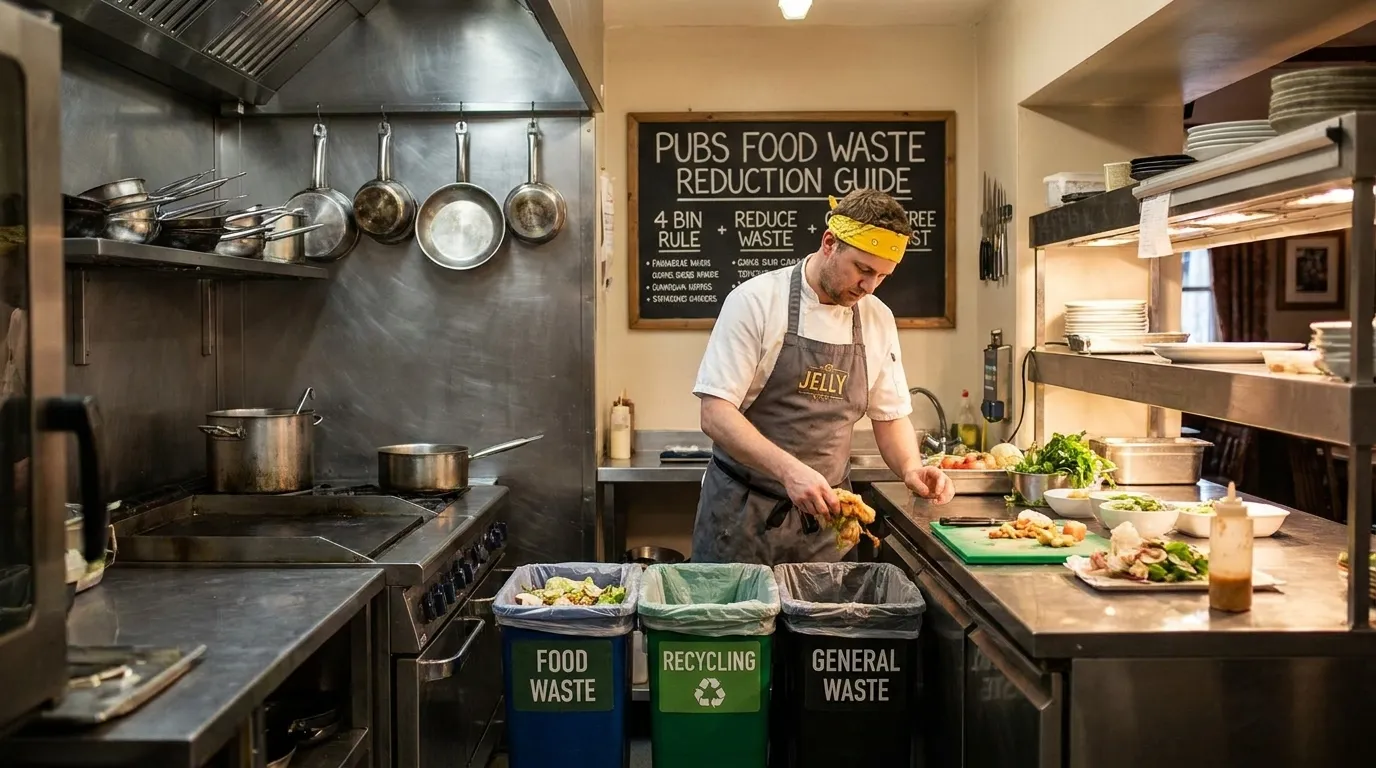
Step 1 establishes a baseline so operators know where waste occurs and what it costs by weight and by pound value. This baseline turns food waste from a vague problem into specific line items you can act on.
Start with WRAP’s Guardians of Grub free 7-day tracking sheet. Weigh preparation, spoilage and plate waste separately, then convert quantities to cost using actual purchase prices. WRAP’s Hospitality and Food Service (HaFS) sector research shows that, on average across the whole sector, 21% of food waste arises from spoilage, 45% from food preparation and 34% from consumer plates. Each category needs a different operational fix.
The inputs required are the Guardians of Grub tracking sheet, bin weights, and purchase prices. Success at this stage looks like a one-week baseline showing waste by category and by cost. Without this baseline, every subsequent intervention is guesswork. For a deeper guide to measurement methodology, see How to Measure Food Waste in Hospitality: 2026 Guide.
Start Your Baseline And Connect With Jelly
Step 2: Fix Procurement And Stock Control At The Source
Once you have a baseline, the next priority is preventing waste before it happens by fixing the data that drives ordering. This is where most operators lose margin without realising it, and it is the section that separates this playbook from generic food waste guides.
Invoice-level price tracking is the mechanism that prevents over-ordering and waste at source. When operators cannot see that a supplier has increased the price of a key ingredient, they cannot adjust order quantities, renegotiate, or reprice dishes in time. By the time the monthly accountant report arrives, the margin has already eroded.
Jelly addresses this directly. Jelly automatically scans every line item of an invoice via photo or email, digitising quantity, SKU, price and tax, and surfaces spending by supplier in a single dashboard. Jelly’s Price Alert flags every ingredient price increase or decrease, showing by how much and from which supplier, so operators can challenge creeping prices, claim credit notes and adjust before margins erode. Amber restaurant in East London saves £3,000–£4,000 per month using Jelly’s invoice automation and price change alerts, achieving approximately 68 times return on investment. As Murat Kilic, Chef-Owner at Amber, puts it: “Jelly keeps my business alive.”
Jelly’s automated invoice management integrates directly with Xero (with Sage coming soon) and cuts bookkeeping time by around 90%. Because onboarding is quick, users see initial value in the first week and cut food costs by 3% on average within three months. All of this comes at a flat rate of £129 per month per location, with no variable charge per user or feature.
Sushi Revolution’s monthly stocktake using Jelly takes 5–20 minutes, down from 2–3 hours previously. This time saving comes from having clean, automated invoice data driving stock records rather than manual spreadsheet entry.
The inputs required are supplier invoices (via photo or email), a supplier list, and stock records. Success looks like every invoice digitised, every price change flagged, and a weekly view of spending by supplier.
See Jelly’s Invoice And Stock Features In Action
Step 3: Cost Dishes Live And Engineer The Menu Around Real Margins
After procurement data is under control, the focus shifts to live dish costing so you stop over-ordering low-margin or low-selling dishes. Over-ordering is driven by uncertainty, as chefs order what they think they will need rather than what sales data shows they will sell.
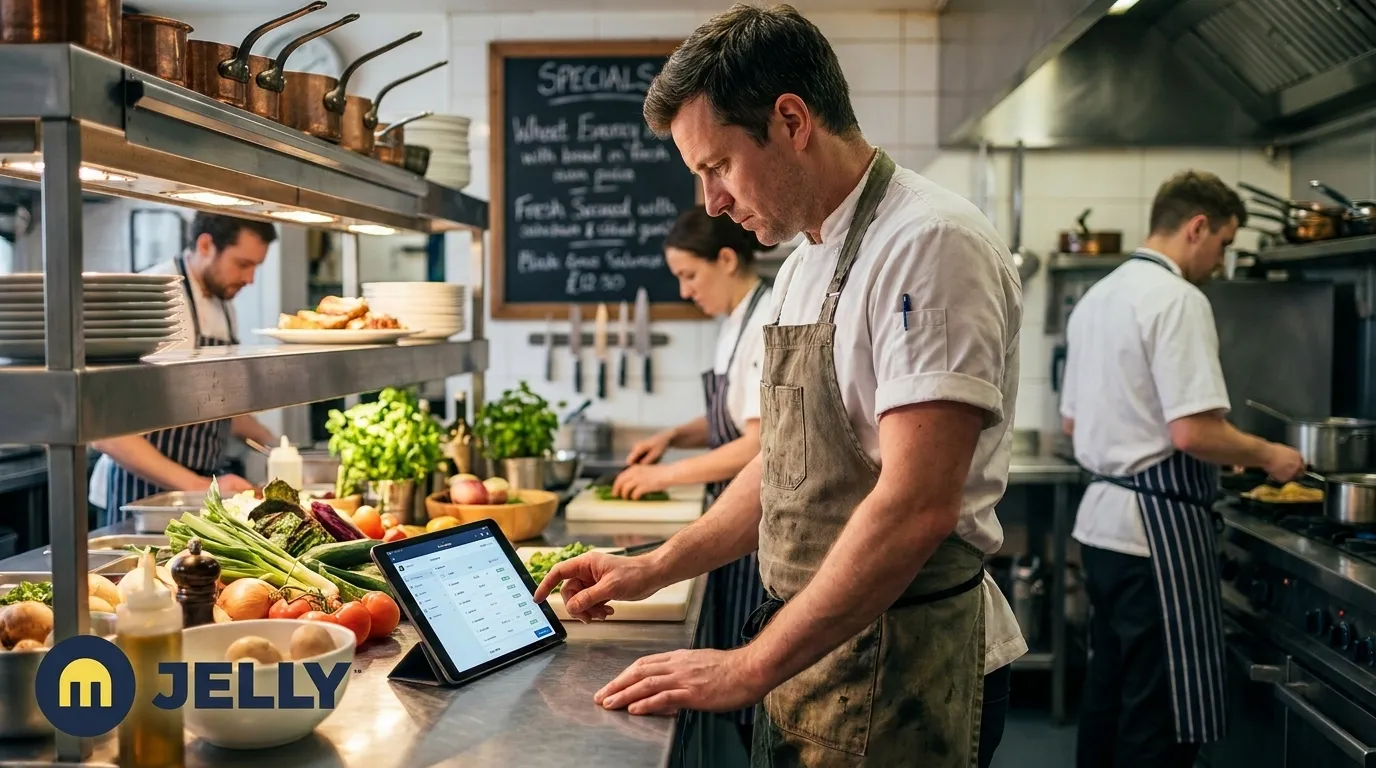
Jelly’s Kitchen section lets chefs build a dish recipe by clicking on ingredients already populated from scanned invoices. All unit conversions and maths are handled automatically. What used to take 28 minutes in a spreadsheet now takes approximately 3 minutes. Because ingredient costs update with every new invoice, the gross profit margin per dish is always live. A red percentage appears when a dish drops its margin, and green appears when it grows. Jelly users add 2 percentage points to gross margins on average in the first three months.
Jelly’s Menu Engineering (Sales Mix) report integrates with Square, EPOS Now, Toast and Lightspeed via real-time API. This integration shows which dishes are most popular and most profitable, allowing operators to cut or rework slow sellers before they cause over-ordering. Connecting any supported POS takes about five minutes and automates 2–5 hours of weekly work, delivering real-time margins and sales-mix data. These POS systems are complementary partners that Jelly works alongside.
Sushi Revolution uses Jelly to set separate target gross profits on dine-in and delivery menus, accounting for 30% delivery commissions, resulting in actual gross profits 2–3% higher on average. One operator improved gross profit from 65% to 72% within 12 weeks on approximately £500,000 in revenue.
The inputs required are recipe data, scanned invoices, and POS sales data. Success looks like every dish having a live GP margin and a sales-mix report showing which dishes to cut, rework or promote.
Get Live Dish Costing And Menu Insights
Step 4: Redistribute Surplus Food Safely
Once prevention and menu engineering are in place, the next step is to recover some cost and reduce waste by redistributing safe surplus. Redistribution sits below prevention in the food and drink waste hierarchy, yet it remains a meaningful step for food that cannot be prevented or used in service.
Too Good To Go and Olio are the two most widely used redistribution platforms for UK hospitality operators. Local charities and food banks are also viable recipients. Before transferring any food, operators must understand the UK food safety rules that govern donation.
Food cannot be supplied after its use-by date, except where it has been safely frozen or cooked before that date and appropriately re-labelled. Best-before dates relate to quality rather than safety, so best-before food can be redistributed if it passes quality checks and is judged to be of acceptable condition. Chilled and frozen food must be kept at appropriate temperatures throughout storage and transport, and the donor remains responsible for applying appropriate food-safety and hygiene controls. To ensure these conditions are met, operators should agree practical acceptance criteria with the charity or redistributor before any transfer takes place. These criteria cover product condition, date life, packaging integrity and storage instructions.
The inputs required are surplus stock records, date labelling, and storage and transport controls. Success looks like a documented surplus redistribution process that is safe, compliant and recovers some cost.
Explore Data-Driven Surplus Management With Jelly
Step 5: Recycle What Cannot Be Prevented
The final step is to dispose of unavoidable food waste legally and responsibly. Recycling sits at the bottom of the food and drink waste hierarchy, so it follows prevention, menu engineering and redistribution.
Under the UK’s duty of care rules, commercial hospitality businesses are legally responsible for arranging their own waste collections and cannot use household collections, bring banks or household waste recycling centres for business waste. Businesses must use a registered waste carrier holding a Waste Carriers Licence and a registered waste disposal facility. Waste Transfer Notes must be retained for two years, and failure to produce required waste documentation can result in prosecution and an unlimited fine.
The inputs required are a commercial waste contract, Waste Transfer Notes, and a collection schedule. Success looks like separate food waste collection in place, documentation retained, and no organic waste sent to landfill.
Tidy Up Your Data Before Paying For Disposal
Common Mistakes To Avoid In UK Hospitality Food Waste Reduction
Several recurring errors cause food waste reduction programmes to stall or fail to deliver measurable margin improvement. Addressing these issues early keeps the five-step sequence on track.
- Treating food waste as a kitchen discipline problem only. Likely cause: assuming chefs control waste through behaviour alone. Corrective action: fix procurement and costing data first, because waste usually reflects a data failure before a kitchen failure.
- Skipping measurement. Likely cause: wanting to act fast. Corrective action: run the Guardians of Grub 7-day baseline before changing anything. Without a baseline, there is no way to know whether interventions are working.
- Relying on monthly accountant reports. Likely cause: trusting the existing finance process. Corrective action: move to invoice-level price visibility so operators can react the same week a supplier increases a price, rather than six weeks later.
- Letting spreadsheets drift. Likely cause: manual data entry that falls behind during busy periods. Corrective action: automate invoice scanning and live dish costing so the data stays current without relying on anyone to update it manually.
- Investing in waste-tracking technology before fixing procurement. Waste-tracking technologies such as Winnow and Orbisk measure food waste at the bin, with Winnow capturing waste inside the bin after disposal and Orbisk capturing items above the bin before they are thrown in. These systems provide data and insights that kitchens can act on to reduce future waste. Jelly focuses on preventing waste at source by fixing the procurement and costing data that drives ordering decisions.
Fix Data Gaps That Create Waste
How To Measure Success Of Your Food Waste Programme
A food waste reduction programme is working when four conditions are met. A WRAP Guardians of Grub baseline exists, invoice-level price visibility is in place, every dish has a live GP margin, and a sales-mix view shows which dishes drive profit.
Directional indicators to track include:
- Reduced food cost percentage week on week
- Fewer invoice discrepancies and supplier overcharges
- Faster reaction to supplier price changes, measured in days rather than weeks
- Reduced admin time on invoice processing and dish costing
Jelly users save 10–20 hours of admin per month and add 2 percentage points to gross margins. Stuart Noble, Head Chef at Cairn Lodge Hotel, reported slashing food costs by 5% in a single month after implementing Jelly’s live dish costing and price alerts. Ruth Seggie, Owner of The Howard Arms, reached 80% gross profit after using Jelly, up from a projected 60%, and can now react to cost changes instantly rather than waiting weeks for reports.
Track These Metrics With Jelly
Advanced Tips And Next Steps For Multi-Site Operators
For operators expanding to multiple sites, the priority is standardisation across locations. A central recipe book, consistent supplier price tracking across all locations, and shared margin visibility for owners and finance managers create this consistency.
Jelly supports this through its centralised Cookbook and multi-location invoice management, allowing operators to compare performance across sites without relying on each kitchen to self-report. Adjacent tasks worth tackling after completing the five-step sequence include connecting a POS system to automate 2–5 hours of weekly work and deliver real-time sales-mix data. Operators can also use Jelly’s delivery menu creation feature to factor in delivery commission overheads and protect GP on third-party platforms.
The food and drink waste hierarchy remains the framework for deciding what to prioritise next. Prevention always comes first. For a broader view of compliance obligations, see UK Hospitality Food Waste Regulations and Compliance 2026.
Plan Your Multi-Site Rollout With Jelly
Approach Comparison For Food Waste Management
The table below compares three common approaches to food waste management: manual tracking, waste-tracking technology, and Jelly. It highlights what each approach measures, whether it prevents waste at source, and the typical payback period.
| Approach | What It Measures | Prevents Waste At Source? | Typical Payback |
|---|---|---|---|
| Manual tracking (Guardians of Grub sheet) | Waste by category and cost | No, measures after the fact | Immediate (free) |
| Waste-tracking technology (Winnow, Orbisk) | Waste at the bin by ingredient | No, measures after the fact | 6–12 months |
| Jelly (invoice scanning + live costing + POS) | Ingredient prices, dish GP, sales mix | Yes, fixes procurement and costing data | First week |
This comparison sets up the most common questions operators ask when choosing tools and sequencing their food waste strategy.
Frequently Asked Questions
How Much Food Waste Does UK Hospitality Generate?
UK hospitality generates roughly 1 million tonnes of food waste a year. WRAP research finds that every £1 invested in food waste reduction returns around £14, making waste reduction one of the highest-return operational investments available to hospitality businesses. For most operators, the financial case is compelling and aligns with environmental goals.
What Are The 7 Types Of Food Waste In A Commercial Kitchen?
The seven types are: preparation waste (trim and peel from raw ingredients), spoilage (stock that has passed its best before being used), plate waste (food left by customers), overproduction (too much mise en place prepared for service), over-ordering (excess stock purchased beyond what is needed), expiry waste (ingredients that reach their use-by date unused), and storage waste (food that deteriorates due to poor rotation or temperature control). As mentioned in Step 1, WRAP’s research breaks waste into spoilage, preparation and plate waste, and each group needs a different operational response.
How To Donate Surplus Food Safely In The UK?
Food cannot be supplied after its use-by date, except where it has been safely frozen or cooked before that date and appropriately re-labelled. Best-before food can be redistributed if it passes quality checks and is judged to be of acceptable condition, because best-before dates relate to quality rather than safety. Chilled and frozen food must be kept at appropriate temperatures throughout storage and transport. The donor remains responsible for applying appropriate food-safety and hygiene controls, including HACCP-based food safety management procedures. To keep donations consistent, operators should agree practical acceptance criteria with the charity or redistribution platform before any transfer takes place. These criteria cover product condition, date life, packaging integrity and storage instructions. Too Good To Go and Olio are the two most widely used platforms for UK hospitality operators.
What Technology Helps Hospitality Businesses Track Food Waste?
Winnow and Orbisk use computer vision and scales to measure waste at the bin, capturing ingredient type, weight and timestamp automatically without requiring staff input. WRAP’s Guardians of Grub provides free downloadable tracking sheets, including a 7 day tracking sheet for manually measuring food waste, which can be used to establish a baseline (either directly or as Week 1 data for the Food Tracking Calculator). These tools measure waste after it has occurred. Jelly focuses on preventing waste at source through automated invoice scanning, Price Alert, live dish costing and POS sales-mix data, fixing the procurement and costing data that drives ordering decisions before waste happens.
What Is The Food Waste Hierarchy And How Does It Apply To Hospitality?
The food and drink waste hierarchy published by GOV.UK sets out an eight-option priority order for managing food and drink surplus and waste, where 1 is best and 8 is worst: 1. prevent surplus and waste in your business, 2. redistribute surplus food and drink, 3. make animal feed from former food, 4. process surplus food to make biomaterials, 5. recycle (anaerobic digestion and composting), 6. recover waste by landspreading, 7. recover energy from waste, and 8. dispose (send to sewer and landfill). For hospitality operators, this means fixing procurement and costing data before investing in waste-tracking technology or recycling infrastructure. Operators who lead with recycling spend money on disposal that could have been saved through prevention. The hierarchy is the framework for deciding where to invest time and resource at each stage of a food waste reduction programme.
What Are The Most Effective Ways To Reduce Food Waste In A UK Hospitality Business?
The most effective ways to reduce food waste in a UK hospitality business follow the same five-step sequence set out in this playbook. Operators measure waste for one week using WRAP’s Guardians of Grub tracking sheet, automate invoice scanning so every ingredient price change is visible immediately, cost every dish live and flag any dish whose GP margin drops below target, use POS sales-mix data to cut or rework slow-selling, low-margin dishes, order from recent sales data rather than habit while enforcing FIFO stock rotation, redistribute safe surplus through Too Good To Go, Olio or local charities, and recycle unavoidable food waste through a licensed commercial collection while retaining Waste Transfer Notes for two years.
Real-world complexity, including supplier changes, recipe updates, stock variance and multi-site operations, means this process requires ongoing attention rather than a one-off implementation. The operators who sustain margin improvement are those who automate the data layer so the process runs without depending on manual effort.
Conclusion: Prevent Waste At Source, Protect Your Margin
Reducing food waste in UK hospitality starts with commercial systems and data, then moves into kitchen practice. The five-step sequence, covering measurement, procurement and costing data, menu engineering, redistribution and recycling, is ordered by payback speed for a clear reason. Measurement is free. Procurement fixes pay back in weeks. Menu engineering compounds. Redistribution recovers some cost. Recycling handles what remains.
Operators who fix the data layer first, using invoice-level price visibility, live dish costs and sales-mix reporting, prevent waste at source rather than measuring it after the fact. Jelly gives growing restaurants, pubs and hotels a straightforward way to do this through automated invoice scanning, Price Alert, live dish costing and POS integration.
The next step is simple. Run the 7-day Guardians of Grub baseline, then connect your invoices to Jelly and see your first Price Alert within the week.
Start Your Food Waste Playbook With Jelly